Amplifier Classes Explained: The Complete Guide to Audio Amplifier Technologies (2026 Edition)
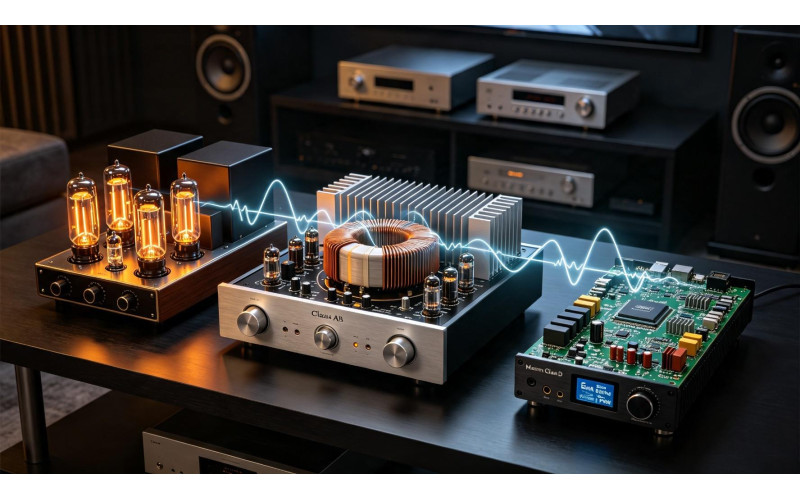
Amplifier Classes Explained – The Ultimate Guide
The audio amplifier is one of the most important components in any sound system. Whether you're listening to music through a pair of bookshelf speakers, powering a professional concert venue, or enjoying a high-end audiophile setup, the amplifier determines how faithfully the original recording is reproduced.
Since the invention of the transistor amplifier in the 1950s, engineers have developed numerous amplifier classes, each designed to solve specific engineering challenges. Some prioritise absolute sound quality, others maximise efficiency, while modern designs strive to deliver both.
Today, amplifier classes range from traditional analogue designs such as Class A and Class AB to highly efficient switching amplifiers like Class D, as well as advanced hybrid topologies including Class G and Class H. Recent innovations such as Gallium Nitride (GaN) transistors and Purifi Eigentakt technology have pushed performance to levels that were once considered impossible.
This comprehensive guide explains every major amplifier class in detail, compares their performance, discusses their advantages and disadvantages, and provides examples of well-known amplifier models that have shaped the history of high-fidelity audio.
The History of Audio Amplifiers
Long before solid-state electronics became common, audio amplification relied on vacuum tubes. Tube amplifiers dominated home audio from the early twentieth century until the late 1960s. Their warm and musical presentation continues to attract enthusiasts today.
The invention of the transistor completely transformed amplifier design. Transistors offered greater reliability, lower maintenance, reduced heat generation, smaller size, and significantly lower manufacturing costs.
During the following decades, engineers continuously improved amplifier efficiency while attempting to preserve the sonic qualities of earlier designs. This effort eventually produced the amplifier classes we know today.
The evolution can be summarised as follows:
- Vacuum Tube Amplifiers (1920s–1960s)
- Class A Transistor Amplifiers
- Class B Amplifiers
- Class AB Amplifiers
- Class G and H Variable Supply Designs
- Class D Switching Amplifiers
- Modern GaN-Based Amplifiers
- Purifi Eigentakt and Advanced Feedback Technologies
Each generation improved efficiency, power density, reliability, and measured performance while reducing heat and power consumption.
Understanding Amplifier Classes
An amplifier class describes how the output transistors conduct electrical current throughout one complete cycle of an audio waveform.
The chosen operating method directly affects:
- Audio quality
- Harmonic distortion
- Crossover distortion
- Power efficiency
- Heat production
- Maximum output power
- Physical size
- Manufacturing cost
There is no universally "best" amplifier class. Instead, each design represents a different compromise between efficiency and sound quality.
For example:
- Class A focuses almost entirely on sound quality.
- Class AB balances sound quality and efficiency.
- Class D emphasises efficiency and compact size.
- Class G and H combine traditional analogue sound with improved efficiency.
Understanding these differences makes it much easier to choose an amplifier that suits your listening habits and budget.
How Amplifiers Work
Every amplifier performs one simple task: it increases the amplitude of a small electrical signal without altering its musical content.
A typical amplifier contains several functional stages:
- Input stage
- Voltage amplification stage
- Driver stage
- Output stage
- Power supply
- Protection circuits
The output stage is where amplifier classes differ.
Different output transistor operating modes create the various amplifier classes discussed throughout this guide.
Why Efficiency Matters
Efficiency measures how much electrical energy is converted into useful audio power.
For example:
- A Class A amplifier may convert only 20–30% of its electrical energy into sound.
- The remaining energy becomes heat.
By comparison:
- Modern Class D amplifiers often exceed 90% efficiency.
Higher efficiency offers numerous advantages:
- Smaller heatsinks
- Lower electricity consumption
- Reduced operating temperatures
- Longer component life
- Smaller and lighter chassis
- Higher output power from compact designs
These advantages explain why Class D technology now dominates Bluetooth speakers, active studio monitors, AV receivers, and many premium Hi-Fi systems.
Common Sources of Distortion
Amplifier classes differ mainly because they attempt to reduce different forms of distortion.
Important types include:
Harmonic Distortion (THD)
Additional harmonics generated by amplifier circuitry that were not present in the original recording.
Crossover Distortion
Occurs when one output transistor turns off while another turns on.
This mainly affects Class B amplifiers.
Intermodulation Distortion (IMD)
Occurs when multiple frequencies interact inside the amplifier.
Switching Noise
Found primarily in Class D amplifiers.
Modern output filters and advanced modulation techniques have reduced switching noise to nearly inaudible levels.
The Importance of Power Supply Design
Many experienced engineers argue that the power supply is just as important as the amplifier topology itself.
A high-quality power supply provides:
- Stable voltage
- High current delivery
- Excellent transient response
- Low noise
- Improved bass control
- Better stereo imaging
For this reason, premium amplifiers often feature oversized toroidal transformers and large capacitor banks, even when using efficient amplifier topologies.
The quality of the power supply frequently has a greater impact on real-world performance than marketing claims about amplifier class alone.
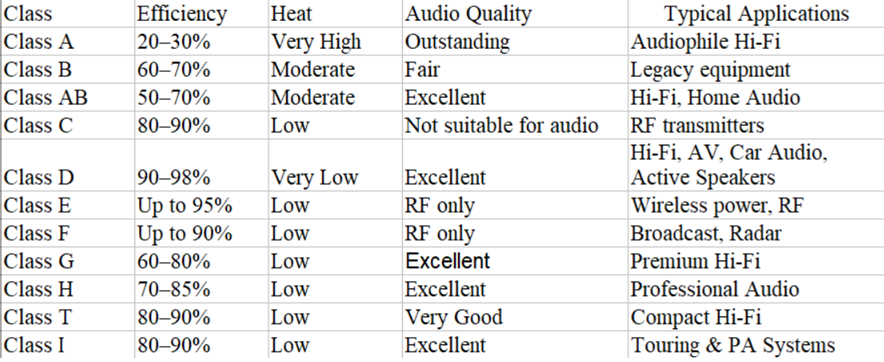
Which Amplifier Class Should You Choose?
For Audiophiles
Recommended: Class A or high-end Class AB
If your primary goal is the most natural, transparent, and refined sound possible, Class A remains a benchmark. Premium Class AB amplifiers also offer exceptional musical performance while generating less heat.
For Everyday Hi-Fi Listening
Recommended: Class AB or modern Class D
These amplifier classes provide an excellent balance of sound quality, efficiency, reliability, and affordability.
For Home Theatre
Recommended: Class D
Modern AV receivers often contain between five and thirteen amplifier channels. The high efficiency of Class D helps reduce heat and allows manufacturers to build compact multi-channel systems.
For Professional Audio
Recommended: Class D or Class H
Professional sound reinforcement requires:
- High output power
- Reliability
- Low weight
- Excellent efficiency
These requirements make modern switching amplifiers the preferred choice.
For Active Loudspeakers
Most active studio monitors and powered speakers now use Class D amplifiers because they are compact, efficient, and capable of delivering substantial power with minimal heat.
For Car Audio
Vehicle electrical systems benefit greatly from efficient amplifiers.
Class D dominates:
- Mono subwoofer amplifiers
- Multi-channel amplifiers
- DSP amplifiers
Common Myths About Amplifier Classes
Myth 1: Class D Means Digital
False.
Class D amplifiers are analogue amplifiers that use high-frequency switching techniques. The audio signal remains analogue throughout the amplification process.
Myth 2: Class A Always Sounds Better
Not necessarily.
A poorly designed Class A amplifier can perform worse than a well-designed Class AB or Class D amplifier.
Overall engineering quality matters far more than amplifier class alone.
Myth 3: More Watts Mean Better Sound
Power output does not determine sound quality.
Important factors include:
- Circuit design
- Power supply quality
- Component selection
- Speaker matching
- Room acoustics
Myth 4: All Class D Amplifiers Sound the Same
False.
Modern Class D amplifiers vary significantly depending on:
- Output stage design
- Feedback topology
- Power supply
- Output filter
- Semiconductor technology
Future Trends
Amplifier technology continues to evolve rapidly.
Emerging developments include:
- Gallium Nitride (GaN) power devices
- Silicon Carbide (SiC) semiconductors
- Artificial Intelligence-assisted calibration
- Integrated DSP correction
- Network-enabled amplifiers
- Ultra-efficient power supplies
- Improved thermal management
- Reduced standby power consumption
Future amplifiers will likely become:
- Smaller
- More efficient
- More intelligent
- More environmentally friendly
- Even closer to perfect linearity
Frequently Asked Questions (FAQ)
What is the best amplifier class?
There is no universal answer. Class A offers exceptional linearity, Class AB provides an excellent balance of performance and efficiency, while modern Class D combines outstanding sound quality with very high efficiency.
Which amplifier class is most efficient?
Class D currently offers the highest efficiency for audio amplification, typically exceeding 90%.
Is Class D suitable for audiophiles?
Yes. Modern designs using technologies such as Purifi Eigentakt, Hypex NCore, and GaN have earned widespread recognition among audiophiles for their excellent performance.
Why do Class A amplifiers get so hot?
Their output transistors remain fully biased and conduct current continuously, even when no music is playing.
Why is Class AB so popular?
It combines excellent sound quality, good efficiency, proven reliability, and reasonable manufacturing cost.
Which amplifier class is used in Bluetooth speakers?
Nearly all Bluetooth speakers use Class D amplifiers because of their high efficiency and compact size.
Which class is best for subwoofers?
Class D is ideal thanks to its efficiency, high output power, and excellent low-frequency control.
Are tube amplifiers classified as Class A?
Many single-ended tube amplifiers operate in Class A, although push-pull tube amplifiers may operate in Class AB.
Is higher efficiency always better?
Not necessarily. Efficiency reduces heat and power consumption, but overall sound quality depends on the complete amplifier design.
Can amplifier class alone determine sound quality?
No. The power supply, component quality, PCB layout, output stage design, and overall engineering are equally important.
People Also Ask
- What is the difference between Class A and Class AB amplifiers?
- Is Class D really as good as Class AB?
- Why are Class A amplifiers expensive?
- Which amplifier class is best for vinyl records?
- What amplifier class do professional studios use?
- Are modern Class D amplifiers truly audiophile?
- Which amplifier class lasts the longest?
- Why do premium amplifiers weigh so much?
- Does amplifier class affect speaker compatibility?
- What is the future of amplifier technology?
Final Thoughts
Choosing an amplifier is about much more than selecting a particular class. While amplifier topology influences efficiency, distortion, and heat generation, the overall engineering of the product—including its power supply, component quality, thermal design, and implementation—has an even greater impact on real-world performance.
Class A remains the icon of traditional audiophile design, Class AB continues to be the trusted all-rounder for high-fidelity systems, and Class D has evolved into a mature technology capable of delivering exceptional sound quality with industry-leading efficiency.
Whether you're building a reference stereo system, upgrading your home theatre, or assembling a professional sound reinforcement rig, understanding amplifier classes allows you to make an informed decision and choose equipment that best matches your listening preferences, budget, and technical requirements.