
Hybrid STK Amplifier Chips: The Backbone of Vintage Audio Systems
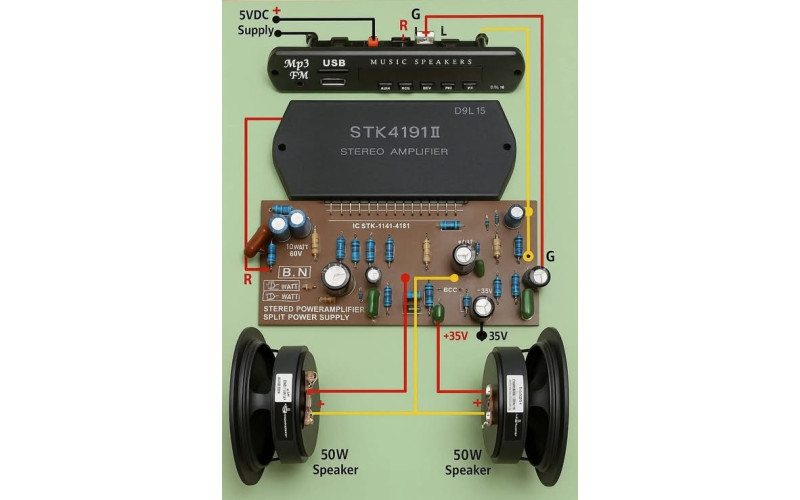
Hybrid STK Amplifier Chips: The Backbone of Vintage Audio Systems
Hybrid STK amplifier chips were once a cornerstone of consumer audio electronics. Found in countless stereo receivers, integrated amplifiers, and home theatre systems from the 1970s through the early 2000s, these modules helped manufacturers reduce design complexity while delivering reliable power output.
Today, STK modules remain highly relevant among vintage audio enthusiasts, repair technicians, and DIY electronics hobbyists. However, their role has shifted — from mainstream production components to legacy parts in need of careful replacement and restoration planning.
Understanding the history, purpose, and modern challenges of STK amplifier chips is essential for anyone working with classic audio equipment.
What Are Hybrid STK Amplifier Chips?
STK modules are hybrid integrated circuits, originally developed by Sanyo. Unlike conventional monolithic ICs, hybrid modules combine multiple semiconductor dies, thick-film resistors, and supporting circuitry on a ceramic substrate inside a single package.
This design allowed manufacturers to integrate complex amplifier stages into one compact unit.
Instead of building a full power amplifier from dozens of discrete transistors and resistors, engineers could install a single STK module and dramatically simplify production.
These modules were widely used in brands such as Technics, Yamaha, Pioneer, and Sansui.
The History of STK Amplifier Modules
The STK series gained popularity during the late 1970s and peaked throughout the 1980s and 1990s.
At the time, consumer demand for affordable yet powerful home audio systems was growing rapidly.
Manufacturers needed amplifier solutions that were compact, efficient to assemble, and consistent in performance.
Hybrid modules solved this challenge.
By integrating multiple amplifier stages into a single package, STK chips reduced assembly time and minimised circuit board complexity. This made them ideal for mass-market audio products.
As semiconductor technology evolved, newer amplifier designs — especially Class D and improved monolithic ICs — gradually replaced STK hybrids in modern products.
Eventually, original production of many STK modules was discontinued, leaving a large installed base of equipment dependent on ageing and often unavailable parts. Community reports and market analysis indicate that genuine original units are now scarce, with many listings being clones or relabeled devices.
The Purpose of Hybrid STK Chips
The main purpose of STK chips was to provide:
Compact amplifier design
Simplified manufacturing
Consistent electrical performance
Reduced component count
Cost-effective power amplification
For manufacturers, this meant lower production costs.
For consumers, it meant affordable audio systems with respectable output power.
For engineers, it offered a practical middle ground between fully discrete amplifiers and smaller low-power IC solutions.
Pros of Hybrid STK Amplifier Chips
1. Simplified Circuit Design
A single module replaced many discrete components, making amplifier construction faster and cleaner.
2. Compact Size
STK modules allowed manufacturers to design slimmer and more efficient chassis layouts.
3. Reliable Factory Matching
Because internal components were assembled, electrical matching was more consistent than with hand-selected discrete parts.
4. Good Performance for Consumer Audio
When properly designed, many STK amplifiers delivered solid sound quality suitable for home listening.
Some enthusiasts still appreciate their “vintage warmth” in older systems.
Cons of Hybrid STK Amplifier Chips
1. Limited Repairability
If the module failed, internal repairs were generally impossible.
Replacement was the only realistic solution.
2. Heat Sensitivity
Improper heatsinking often led to thermal stress and premature failure.
3. Obsolescence
Original production stopped for many popular models, making sourcing difficult.
4. Counterfeit Market
A major modern issue is the prevalence of fake or low-quality replacement modules sold online.
These often have reduced die sizes, poor bonding, or mismatched specifications.
5. Lower Flexibility
Unlike discrete designs, STK modules cannot be modified internally for upgrades or tuning.
Current Situation: What If You Need a Replacement?
Replacing a failed STK amplifier chip today requires caution.
Option 1: Genuine NOS (New Old Stock)
These are original, unused parts from old inventory.
They are rare and often expensive, but usually offer the best compatibility.
Option 2: Modern Clones
Widely available, but quality varies significantly.
Some work adequately, while others fail quickly.
Verification of seller reputation is essential.
Option 3: Discrete Retrofit Boards
Many technicians now recommend custom replacement boards built with modern components such as LM-series amplifiers or discrete transistor stages.
These can improve reliability and serviceability.
In repair communities, retrofit solutions are often preferred for valuable equipment rather than gambling on questionable clone modules.
Are STK Amplifier Chips Still Worth Using?
For restoring vintage equipment, STK modules remain important.
If originality matters, sourcing a proper replacement may be worthwhile.
For long-term reliability, however, modern retrofit solutions often make more sense.
The decision depends on whether the goal is:
historical authenticity
cost-effective repair
improved durability
better audio performance
Final Thoughts
Hybrid STK amplifier chips played a crucial role in the evolution of consumer audio electronics.
They offered a practical and affordable way to deliver powerful sound in compact systems for decades.
While their limitations are more obvious today, their legacy remains strong in vintage audio culture.
For collectors and repair professionals, understanding STK technology is key to preserving classic equipment and making smart replacement choices in a market filled with both opportunity and risk.
In the world of vintage audio restoration, STK modules are not just components — they are part of amplifier history.
Posted by
System Administrator
News
views (750)