
Class C Amplifiers
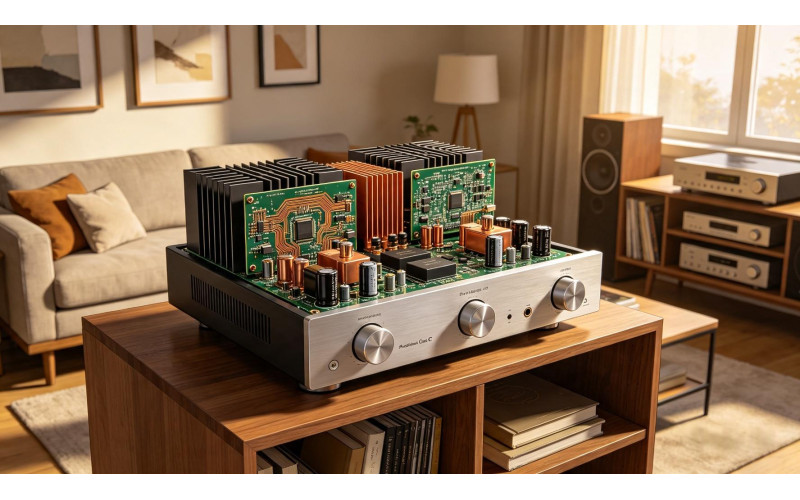
What Is a Class C Amplifier?
Class C amplifiers are fundamentally different from the amplifier classes commonly used in home audio. Unlike Class A, B, or AB designs, a Class C amplifier conducts current for less than 180° of the input signal.
This extremely short conduction angle results in very high efficiency but introduces severe distortion, making Class C unsuitable for reproducing music.
Instead, these amplifiers are primarily used in radio-frequency (RF) applications, where resonant circuits reconstruct the waveform.

How Class C Works
The output transistor is heavily biased so that it switches on only during a small portion of the signal cycle.
A tuned LC circuit then filters and reconstructs the desired waveform.
Without this tuned circuit, the output would be highly distorted.

Advantages
• Extremely high efficiency (up to 90%)
• Very little heat generation
• Compact design
• Excellent for RF transmission

Disadvantages
• Extremely high distortion
• Not suitable for audio reproduction
• Requires tuned output circuits

Typical Applications
• Radio transmitters
• RF power amplifiers
• Communication systems
• Oscillators

Class D Amplifiers
What Is a Class D Amplifier?
Class D is one of the most important developments in amplifier technology over the past few decades. Despite the name, the letter D does not stand for "Digital."
A Class D amplifier is an analogue switching amplifier that uses pulse-width modulation (PWM), pulse-density modulation (PDM), or similar techniques to control its output devices.
Instead of operating continuously like Class A or AB, the output transistors switch fully on or off hundreds of thousands—or even millions—of times per second.
This dramatically reduces power losses.

How Class D Works
The incoming analogue audio signal is converted into a high-frequency switching waveform.
The output MOSFETs rapidly switch between fully conducting and fully non-conducting states.
Because transistors dissipate very little power while fully on or fully off, efficiency is exceptionally high.
A low-pass output filter removes the switching frequency and reconstructs the original analogue audio waveform for the loudspeaker.

Why Class D Became So Popular
Earlier Class D amplifiers were criticised for:
• Audible switching noise
• Limited bandwidth
• Higher distortion
• Poor damping factor
Modern technology has transformed the situation.
Today's premium Class D amplifiers achieve distortion figures below 0.001%, excellent linearity, and outstanding signal-to-noise ratios. Many now compete directly with the finest Class AB amplifiers.

Advantages
• Outstanding efficiency (90–98%)
• Very low heat generation
• Compact and lightweight
• Smaller power supplies
• Lower electricity consumption
• High output power
• Excellent reliability

Disadvantages
• Output filter design is critical
• Poor implementations may introduce switching artefacts
• Sound quality varies greatly depending on the design

Typical Applications
Class D technology is now used in:
• Stereo amplifiers
• AV receivers
• Active loudspeakers
• Studio monitors
• Bluetooth speakers
• Portable audio devices
• Car audio systems
• Professional PA amplifiers
• Subwoofer amplifiers

Famous Class D Amplifiers
Examples include:
• NAD M33
• NAD C298
• Lyngdorf TDAI-3400
• Bel Canto e.One REF601M
• Topping PA5 II
• Fosi Audio V3
• SMSL AO300
• Hypex NC502MP-based amplifiers
• Purifi 1ET400A-based amplifiers
• Orchard Audio Starkrimson (GaN)

Sound Characteristics
Modern Class D amplifiers are often described as:
• Neutral
• Highly detailed
• Fast and precise
• Tight, controlled bass
• Low background noise
• Excellent dynamics
Many listeners can no longer distinguish premium Class D amplifiers from high-end Class AB designs in controlled listening tests.

Class E Amplifiers
What Is a Class E Amplifier?
Class E amplifiers are another switching amplifier topology designed primarily for radio-frequency applications rather than audio.
They use carefully timed switching and resonant circuits to minimise power losses.

Advantages
• Extremely high efficiency
• Very low switching losses
• Compact design
• Excellent for RF applications

Disadvantages
• Unsuitable for high-fidelity audio
• Requires carefully designed resonant networks
• Limited audio applications

Typical Applications
• RF transmitters
• Wireless charging systems
• Industrial electronics
• Scientific equipment

Class F Amplifiers
What Is a Class F Amplifier?
Class F amplifiers improve efficiency by shaping voltage and current waveforms using harmonic tuning.
Special resonant circuits suppress unwanted harmonics and maximise efficiency.
Like Class C and E, Class F amplifiers are intended for RF systems rather than music playback.
| Advantages | Disadvantages | Applications |
| Extremely high efficiency | Complex implementation | Broadcast transmitters |
| Reduced switching losses | Not suitable for Hi-Fi audio | Microwave communications |
| High output power capability | Requires harmonic tuning networks | Radar system |
| RF laboratory equipment |
Advantages
• Extremely high efficiency
• Reduced switching losses
• High output power capability

Disadvantages
• Complex implementation
• Not suitable for Hi-Fi audio
• Requires harmonic tuning networks

Applications
• Broadcast transmitters
• Microwave communications
• Radar systems
• RF laboratory equipment

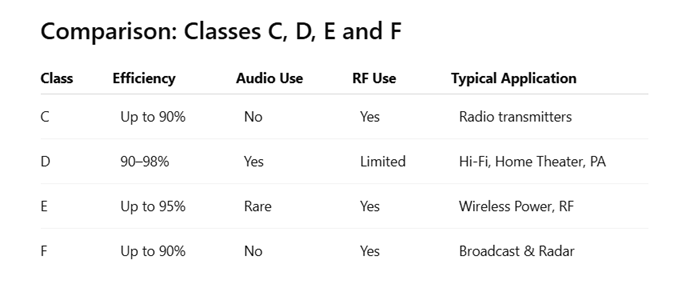

Why Class D Is the Future of Consumer Audio
Over the last twenty years, Class D technology has experienced remarkable progress thanks to improvements in semiconductor devices, digital control techniques, and feedback systems.
Modern Class D amplifiers now offer:
• Exceptional measured performance
• Compact form factors
• Lower manufacturing costs
• Reduced energy consumption
• High power output
• Excellent reliability
As a result, Class D has become the preferred choice for many manufacturers of Hi-Fi equipment, powered speakers, home theatre receivers, and professional audio systems.
While Class A and Class AB continue to hold a special place among audiophiles, the gap in sound quality has narrowed significantly. Today's best Class D amplifiers demonstrate that high efficiency and outstanding musical performance can coexist in a single design.