
Class G Amplifiers
What Is a Class G Amplifier?
Class G amplifiers were developed to improve the efficiency of traditional Class AB designs without sacrificing their sound quality. Instead of operating from a single fixed power supply voltage, Class G amplifiers use multiple power supply rails.
At low listening levels, the amplifier runs from a lower voltage supply, reducing wasted energy. When the music demands more power, it automatically switches to higher voltage rails.
This approach significantly reduces heat while preserving the linear operation of the output stage.

How Class G Works
A conventional Class AB amplifier always operates from its maximum supply voltage, even during quiet passages. Most of this energy is converted into heat.
A Class G amplifier monitors the output signal continuously.
• Low-level signals use the low-voltage rails.
• Loud musical peaks activate higher-voltage rails.
• Switching occurs automatically within microseconds.
The listener experiences the same musical performance while the amplifier operates far more efficiently.

Advantages
• Higher efficiency than Class AB
• Lower operating temperature
• Reduced electricity consumption
• Excellent sound quality
• Ideal for powerful integrated amplifiers

Disadvantages
• More complex circuitry
• Higher manufacturing cost
• Sophisticated power supply required

Typical Applications
Class G amplifiers are commonly found in:
• Premium Hi-Fi amplifiers
• High-power integrated amplifiers
• Home theatre receivers
• Professional monitoring systems

Examples of Class G Amplifiers
• Arcam A49
• Arcam FMJ A39
• Arcam AVR550
• Arcam AVR850
• NAD M22
• Cambridge Audio Edge W (hybrid implementation)

Class H Amplifiers
What Is a Class H Amplifier?
Class H is closely related to Class G but goes one step further.
Instead of switching between several fixed voltage rails, the power supply continuously adjusts its output voltage to match the incoming audio signal.
The amplifier receives only the voltage it actually needs at any given moment.

How Class H Works
A tracking power supply follows the music signal in real time.
As the output voltage rises, the power supply increases accordingly.
As the signal decreases, the supply voltage drops.
This dramatically reduces wasted energy while maintaining the excellent linearity of the output stage.

Advantages
• Excellent efficiency
• Lower heat generation
• High output power
• Reduced weight
• Reliable operation

Disadvantages
• Complex power supply
• Higher design cost
• Mainly used in larger amplifiers

Typical Applications
Class H amplifiers are widely used in:
• Concert amplifiers
• Touring sound systems
• Installed PA systems
• Cinema amplifiers
• High-power subwoofer amplifiers

Examples
• Crown XLS Series
• QSC GX Series
• Behringer NX Series
• Lab Gruppen FP Series
• Peavey IPR Series

Class T Amplifiers
What Is a Class T Amplifier?
Class T is a proprietary amplifier technology originally developed by Tripath Technology.
Although often presented as a separate amplifier class, it is essentially an advanced form of Class D with sophisticated digital control algorithms that improve switching accuracy and reduce distortion.
Tripath amplifiers gained a loyal following because they delivered impressive sound quality from remarkably small and affordable products.

Advantages
• High efficiency
• Compact size
• Excellent value
• Surprisingly refined sound

Disadvantages
• Proprietary technology
• Limited availability
• Tripath ceased operations, reducing long-term support

Famous Examples
• Sonic Impact T-Amp
• Trends Audio TA-10
• KingRex T20
• Audioengine N22 (early versions)

Class I Amplifiers
What Is a Class I Amplifier?
Class I amplifiers are designed primarily for professional audio applications.
The output stage uses complementary switching techniques to achieve very high efficiency while maintaining low distortion at high power levels.
These amplifiers are commonly found in touring systems and large venue installations.

Advantages
• Very high efficiency
• High output power
• Excellent reliability
• Low operating temperatures

Applications
• Stadium sound systems
• Concert touring
• Permanent installations
• Professional cinema

Examples
• Lab Gruppen PLM Series
• Lab Gruppen IPD Series
• Selected professional ICEpower-based amplifiers

Modern Class D Technologies
The latest generation of Class D amplifiers has evolved far beyond early switching designs. Several innovative technologies now dominate the high-performance audio market.

Hypex UcD
Developed in the Netherlands, Universal Class D (UcD) introduced self-oscillating feedback, providing excellent stability and low distortion.
Advantages
• Low distortion
• Excellent damping factor
• Smooth frequency response
• Outstanding reliability
Popular manufacturers using UcD modules include:
• NAD
• DIY builders
• Boutique Hi-Fi manufacturers

Hypex NCore
NCore represents a significant evolution of the UcD concept.
It offers:
• Extremely low distortion
• Outstanding signal-to-noise ratio
• Exceptional linearity
• Excellent loudspeaker control
Examples include:
• NAD C298
• Apollon Audio amplifiers
• Nord Acoustics amplifiers
• ATI power amplifiers

Purifi Eigentakt
Purifi Eigentakt is widely regarded as one of the most advanced Class D technologies available today.
Designed by Bruno Putzeys and his engineering team, Eigentakt dramatically reduces distortion across the entire frequency range while maintaining remarkable efficiency.
Key Features
• Ultra-low THD
• Extremely low IMD
• Excellent load independence
• Exceptional transient response
• Near-perfect measurements
Examples include:
• NAD M23
• NAD M33
• March Audio P452
• Apollon Purifi Series
• Audiophonics Purifi amplifiers
Many reviewers consider Purifi Eigentakt among the finest amplifier technologies currently available.

ICEpower
Originally developed by Bang & Olufsen, ICEpower modules have become one of the most widely used switching amplifier platforms in the industry.
They combine:
• High efficiency
• Compact design
• Proven reliability
• Good sound quality
Manufacturers using ICEpower include:
• Bang & Olufsen
• Jeff Rowland
• Bel Canto
• Wyred 4 Sound

Pascal Audio
Pascal Audio develops high-performance Class D amplifier modules primarily for professional and premium consumer applications.
Their amplifiers are known for:
• Exceptional dynamic capability
• High current delivery
• Low distortion
• Excellent reliability
These modules are used by several high-end loudspeaker manufacturers and professional audio brands.

Gallium Nitride (GaN) Amplifiers
One of the biggest recent advances in amplifier technology is the adoption of Gallium Nitride (GaN) FET transistors.
Compared with traditional silicon MOSFETs, GaN devices switch much faster and with lower losses.
Benefits include:
• Reduced switching distortion
• Improved efficiency
• Lower heat
• Better transient response
• Cleaner high-frequency reproduction
Examples include:
• Orchard Audio Starkrimson
• AGD Productions Tempo
• AGD Productions Audion
• Peachtree GaN1
• Peachtree GaN400
Many engineers believe GaN technology represents the next major step in the evolution of high-performance Class D amplifiers.

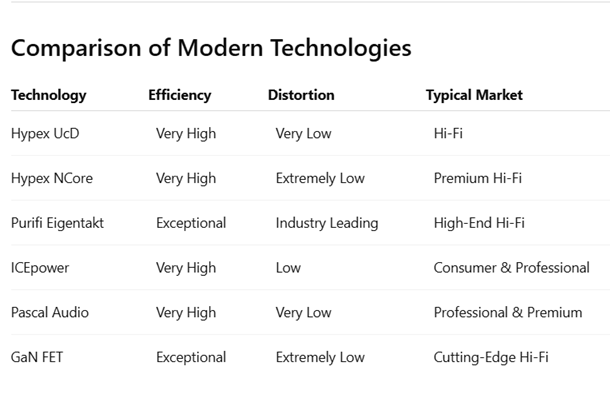

Why These Technologies Matter
Today's amplifier landscape is no longer defined solely by traditional amplifier classes. Advanced switching architectures, innovative feedback systems, and next-generation semiconductor materials have enabled Class D amplifiers to achieve performance levels once associated only with the finest Class A and Class AB designs.
As a result, many of the world's leading Hi-Fi manufacturers now rely on advanced Class D platforms for flagship products, combining exceptional sound quality with outstanding efficiency, compact size, and long-term reliability.