
Class A Amplifiers
Amplifier Classes Explained – Part 2
Class A Amplifiers
What Is a Class A Amplifier?
Class A is considered the oldest and purest solid-state amplifier topology. In a Class A amplifier, the output transistor (or output transistors in a push-pull configuration) conducts current during the entire 360° of the audio waveform.
Unlike other amplifier classes, the output devices never switch completely off. They remain biased at all times, even when no music is playing. This constant operation eliminates crossover distortion and produces an exceptionally linear output.
The trade-off is extremely poor efficiency and substantial heat generation.

How Class A Works
A Class A amplifier continuously draws current from the power supply regardless of the audio signal level.
Even at idle, it consumes a significant amount of electricity and dissipates most of that energy as heat. For this reason, Class A amplifiers require:
• Large heatsinks
• Heavy-duty power supplies
• Oversized transformers
• Excellent ventilation
Many Class A amplifiers become warm—or even hot—to the touch within minutes of being switched on. This is normal.

Advantages of Class A
Class A designs remain highly respected among audiophiles for several reasons:
• Extremely low distortion
• No crossover distortion
• Excellent linearity
• Outstanding low-level detail
• Smooth, natural sound
• Wide soundstage
• Superb imaging
• Excellent microdynamics
Many listeners describe the sound as effortless, refined, and highly musical.

Disadvantages of Class A
Despite their sonic advantages, Class A amplifiers have notable drawbacks:
• Low efficiency (typically 20–30%)
• High electricity consumption
• Significant heat generation
• Large size and weight
• Expensive to manufacture
• Higher purchase price
For these reasons, Class A amplifiers are generally found in premium Hi-Fi systems rather than mass-market products.

Typical Applications
Class A amplifiers are commonly used in:
• High-end stereo systems
• Audiophile listening rooms
• Reference headphone amplifiers
• Studio mastering equipment
• Boutique Hi-Fi products

Famous Class A Amplifiers
Some of the most respected Class A amplifiers include:
• Pass Labs XA25
• Pass Labs XA30.8
• Sugden A21SE Signature
• Luxman M-800A
• Accuphase A-80
• Krell KSA-50
• Musical Fidelity A1
• Yamaha B-2 (VFET design)
• First Watt F7
Several manufacturers also operate the first few watts in pure Class A before transitioning to Class AB at higher output levels.

Class B Amplifiers
What Is a Class B Amplifier?
Class B was developed to solve the efficiency problem of Class A.
Instead of keeping both output devices conducting continuously, Class B uses two complementary transistors:
• One amplifies the positive half of the waveform.
• The other amplifies the negative half.
Each transistor conducts for 180° of the signal cycle.
This dramatically reduces power consumption.

How Class B Works
Because each transistor turns completely off for half of the waveform, efficiency improves significantly.
Unfortunately, when one transistor hands the signal over to the other, a small gap can occur around the zero-crossing point.
This creates crossover distortion, the main weakness of Class B amplifiers.

Advantages
Compared with Class A:
• Higher efficiency
• Less heat
• Smaller heatsinks
• Lower manufacturing cost
• Higher output power

Disadvantages
• Noticeable crossover distortion
• Reduced low-level detail
• Less natural sound
• Rarely used in high-end Hi-Fi today
Because of these shortcomings, pure Class B amplifiers are now uncommon in consumer audio.

Typical Applications
Historically, Class B was used in:
• Budget stereo amplifiers
• Consumer electronics
• Public address equipment
• Early transistor receivers
Modern designs usually employ Class AB instead.

Class AB Amplifiers
What Is a Class AB Amplifier?
Class AB combines the strengths of both Class A and Class B.
Each output transistor conducts for slightly more than 180° of the waveform. This small overlap eliminates most crossover distortion while maintaining much better efficiency than Class A.
As a result, Class AB has become the most widely used amplifier class in traditional Hi-Fi.

How Class AB Works
A small bias current keeps both output transistors slightly active around the zero-crossing point.
This prevents the abrupt switching characteristic of Class B and significantly improves linearity.
At low listening levels, many Class AB amplifiers behave similarly to Class A. As power demand increases, they transition smoothly into normal Class AB operation.

Advantages of Class AB
Class AB offers an excellent balance between performance and practicality:
• Very low distortion
• High sound quality
• Good efficiency (typically 50–70%)
• Lower heat than Class A
• Reliable operation
• Wide availability
• Excellent value for money
For many listeners, Class AB provides the "sweet spot" between sound quality, efficiency, and cost.

Disadvantages
Although highly versatile, Class AB still has some limitations:
• Less efficient than Class D
• Heavier than switching amplifiers
• Requires substantial heatsinking
• Higher idle power consumption than Class D

Typical Applications
Class AB amplifiers are widely used in:
• Stereo integrated amplifiers
• Power amplifiers
• Home theater receivers
• Professional studio equipment
• Premium automotive audio
• Active loudspeakers
For decades, Class AB has been regarded as the reference design for high-quality music reproduction.

Famous Class AB Amplifiers
Well-known examples include:
• Yamaha A-S1200
• Yamaha A-S2200
• Yamaha A-S3200
• Marantz PM8006
• Marantz Model 30
• Denon PMA-1700NE
• Rotel RA-1572 MKII
• Cambridge Audio CXA81
• Cambridge Audio CXA61
• Arcam A25
• NAD C368
• Rega Elicit MK5
• Audiolab 9000A
• Musical Fidelity M5si
Many legendary vintage amplifiers from Pioneer, Sansui, Technics, Kenwood, Onkyo, and Sony also employed Class AB output stages.
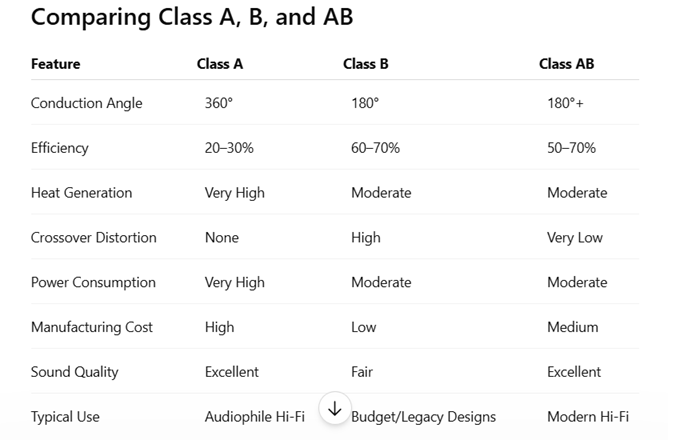

Which One Sounds Best?
There is no universal winner.
• Class A remains the benchmark for purity and natural musical presentation.
• Class B is largely obsolete for high-fidelity applications due to crossover distortion.
• Class AB delivers an outstanding balance of sound quality, efficiency, reliability, and affordability, making it the most common choice for traditional Hi-Fi amplifiers.
While many enthusiasts continue to favour Class A for its sonic character, well-designed Class AB amplifiers can achieve exceptional measured performance and provide an enjoyable listening experience for virtually any music genre.